“Women’s Cotton V-Neck Botanical Print Regular Fitted Anarkali Kurta With Pant & Dupatta” has been added to your cart. View cart
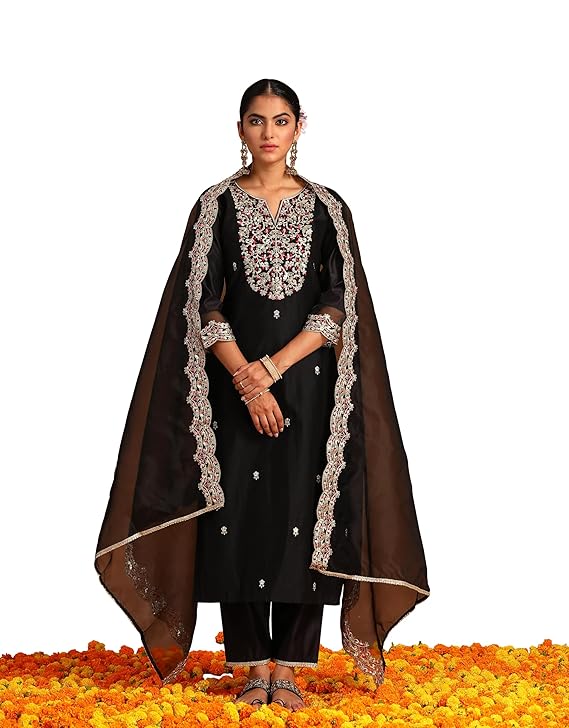
Black Embroidered Straight Kurta Trouser With Dupatta Set
₹8,599.00 Original price was: ₹8,599.00.₹1,499.00Current price is: ₹1,499.00.
SKU: N/A
Categories: party & evening wear, shop by occassion
Description
About this item punjabi suit design
- Color :- Black || Top Fabric :- Rayon Viscose || Dupatta Fabric :- Organza
- Top Length :- Calf Length || Top Shape :- Straight
- Sleeve Type :- Three-Quarter Sleeves || Neck Type :- Round Neck
- Front Length :- 46.5 Inches || Sleeve Length :- 17 Inches
- Note :- Product color might slightly vary due to photographic lighting sources or your monitor settings.
-
The world of ethnic fashion is a vibrant tapestry, and at its very heart lies the timeless and versatile Punjabi suit design. This particular ensemble, a stunning combination of deep black, fluid Rayon Viscose, and ethereal Organza, represents a perfect iteration of contemporary Punjabi suit design. It is a masterclass in balancing
traditional elegance with modern sophistication, making it an indispensable piece in the wardrobe of the discerning woman who appreciates nuanced style.
To fully appreciate this garment, one must embark on a detailed journey through its every facet, from the choice of fabrics to the intricacies of its cut and the styling possibilities it unlocks. This specific Punjabi suit design is not merely an item of clothing; it is a narrative of cultural heritage meeting modern aesthetics.
The Allure of the Palette: The Quintessential Black
The foundational element of this ensemble is its profound black color. In the realm of Punjabi suit design, color is often the first and most powerful communicator. While vibrant hues like fiery reds, sunny yellows,
and royal blues are celebrated, black holds a unique, powerful position. It is the color of ultimate sophistication, of sleek modernity, and of undeniable mystique. A black Punjabi suit design transcends occasions and seasons. It is as appropriate for a solemn evening event as it is for a formal day function, its versatility unmatched.
This choice of black serves as a perfect canvas. It allows the textures of the fabrics to play with light, creating a visual depth that is both subtle and captivating. It provides a dramatic backdrop for any embellishments and ensures that the wearer exudes an aura of confidence and refined power. This Punjabi suit design in black is a statement piece—
it speaks of a woman who is both classic and bold, who understands that true elegance often lies in simplicity and depth rather than in loud exuberance.
Deconstructing the Top: The Rayon Viscose Kameez
The kameez, or the top, is the centerpiece of any Punjabi suit design, and its construction is paramount. This particular kameez is crafted from Rayon Viscose, a fabric choice that is nothing short of brilliant for this style of garment.
Rayon Viscose: A Marriage of Nature and Innovation
Rayon Viscose is a semi-synthetic fiber made from natural sources like wood pulp, processed to create a fabric that boasts the best of both worlds. It is renowned for its exceptional drape, a characteristic that is absolutely criticalfor a straight-cut, calf-length Punjabi suit design. The fabric falls from the shoulders in soft, graceful folds, skimming the body’s contours without clinging uncomfortably. This creates a silhouette that is both flattering and fluid, moving with the wearer in a dance of elegant folds.
Furthermore, Rayon Viscose is highly breathable and absorbent, making it an incredibly comfortable choice for extended wear. It allows air to circulate and absorbs moisture, ensuring the wearer remains cool and comfortable—a practical advantage that enhances the beauty of this Punjabi suit design. The fabric also has a beautiful, subtle sheen
that gives the black color a rich, luminous quality, preventing it from appearing flat or dull. This inherent luster elevates the entire Punjabi suit design, adding a touch of understated luxury.
The Silhouette: Calf-Length and Straight Cut
The specified top length is calf-length, which typically falls midway between the knee and the ankle. This is a profoundly versatile and modern length within the Punjabi suit design spectrum. It offers more modesty and tradition than a shorter length while feeling more contemporary and easier to manage than a full-length, ankle-skimming traditional kameez. It provides ample room for movement and is perfectly suited for both formal and semi-formal occasions.The shape is described as straight. The straight-cut Punjabi suit design is a classic for a reason. It offers a clean, streamlined silhouette that is universally flattering. Unlike an A-line or flared cut, the straight cut maintains a
consistent width from the chest down to the hem. This minimalist approach to the Punjabi suit design emphasizes the vertical line of the body, creating an illusion of height and slimness. It is a shape that exudes modern chic and allows the quality of the fabric and any potential detailing to take center stage.
Neck and Sleeves: The Round Neck and Three-Quarter Sleeves
The neckline and sleeves are crucial elements that define the character of a Punjabi suit design.-
Round Neck (Round Neck): The round neck is a fundamental and timeless neckline in Punjabi suit design. It is simple, elegant, and incredibly wearable. It frames the face gently without being overly revealing, making
-
it appropriate for women of all ages and for a wide array of settings. This simplicity makes it an excellent base for accessorizing; a statement necklace sits beautifully against it, or it can be left bare to highlight the
-
wearer’s features. In this black Punjabi suit design, the round neck provides a clean, sharp finish that complements the modern straight cut perfectly.
-
Three-Quarter Sleeves: Sleeve length can dramatically alter the formality and feel of an outfit. The three-quarter sleeve length (17 inches as specified) is arguably one of the most elegant and practical choices in Punjabi suit design. It ends gracefully between the elbow and the wrist, showcasing the forearm. This length is incredibly flattering,
-
as it narrows the silhouette and draws attention to the slimmest part of the arm. It is also highly functional, offering more coverage and formality than short sleeves while being less restrictive and heavy than full-length sleeves. It strikes a perfect balance, making this Punjabi suit design suitable for all-day wear across various seasons.
The Dimensions: A Perfect Fit
The provided measurements—a front length of 46.5 inches and a sleeve length of 17 inches—are essential for ensuring the perfect fit, which is the cornerstone of a great Punjabi suit design. A well-fitted kameez should feel comfortable, allowfor easy movement, and hang correctly on the body. These measurements suggest a garment designed for a tall or average-height frame, with the calf-length hitting at precisely the right point to maintain its elegant proportion. The 17-inch sleeve will beautifully highlight the wrists, making it an ideal canvas for bracelets or a watch.
The Ethereal Dupatta: The Organza Veil
No Punjabi suit design is complete without its dupatta, the scarf that adds drama, movement, and a final layer of elegance. This ensemble features an Organza dupatta, a choice that introduces texture, volume, and a dreamlike quality to the outfit.
Organza is a thin, plain weave, sheer fabric traditionally made from silk, though now often crafted from synthetic fibers like polyester or nylon. It is characterized by its crispness, transparency, and slight stiffness, which gives it a
beautiful structural quality. When used in a Punjabi suit design, an Organza dupatta does not cling or flow limply; it holds its shape, creating dramatic folds and a sense of volume that is both regal and modern.
The contrast between the matte, fluid drape of the Rayon Viscose kameez and the crisp, sheer volume of the Organza dupatta is a masterstroke of textural play in this Punjabi suit design. The black Organza dupatta would possess a
subtle sheen and a gossamer-like quality, allowing glimpses of the outfit beneath while adding a cloud of sophistication. It can be styled in numerous ways—draped traditionally over both shoulders, pinned at one shoulder for a more
contemporary look, or even wrapped around the neck like a scarf for a fashion-forward statement. The Organza dupetta is what transforms this Punjabi suit design from a simple two-piece into a truly special occasion ensemble.
The Complete Look: Styling This Punjabi Suit Design
The beauty of this specific Punjabi suit design lies in its potential for personalization. Its black base serves as the perfect foundation for a spectrum of styling choices.
-
Jewelry: This is where you can define the occasion. For a stark, modern, and powerful look, pair it with sterling silver or platinum jewelry—chandelier earrings and a statement cuff. To warm up the look and add traditional
-
grandeur, gold jewelry is impeccable. Think elaborate jhumkas (chandelier earrings), a layered necklace, and wide gold bangles. Polki or Kundan sets would add a royal, antique charm to this Punjabi suit design. For a minimalist, you could forego necklaces and opt for a stunning maang tikka (headpiece) and bold rings.
-
Footwear: The choices are endless. Heeled sandals or stilettos in gold, silver, or even a pop of color like red or navy blue would elongate the silhouette. Embroidered juttis (traditional Punjabi flats) would keep the look grounded and authentic to its Punjabi suit design roots while ensuring comfort.
-
Bottoms (Salwar): While the product description focuses on the top and dupatta, the bottom—the salwar—is a key component. A straight-cut kameez like this is incredibly versatile. It can be paired with a traditional
-
straight-fitting salwar, a slim-fitting churidar, or even a contemporary dhoti-style salwar or palazzo pants. A well-fitted churidar would complement the streamlined top perfectly, maintaining the vertical emphasis. Palazzo pants would add volume and a very modern, fashionable twist to the Punjabi suit design.
-
Clutch/Bag: A embellished clutch in gold or silver thread work would be a classic choice. A sleek, structured black clutch would reinforce the modern vibe.
Occasion Wear: Versatility Personified
This Punjabi suit design is a chameleon. Its elegance allows it to adapt to a multitude of events:
-
Formal Gatherings: Wedding functions, cocktail parties, and formal dinners.
-
Festive Celebrations: Diwali, Karva Chauth, Eid, or family gatherings during the holiday season.
-
Cultural Events: Attending a concert, a gallery opening, or a sophisticated party.
-
Office Wear: For a workplace that accepts ethnic wear, this Punjabi suit design is professional, polished, and powerful.
A Note on Variation: The Nature of Perception
The included note—”Product color might slightly vary due to photographic lighting sources or your monitor settings”—is a standard and important disclaimer in the world of online fashion retail, especially for a Punjabi suit design.
The color black, while seemingly straightforward, can have undertones (blue-based, brown-based, etc.) that are challenging to capture with absolute accuracy in photography. The way light reflects off the different textures of the Rayon Viscose and the Organza can also create variations in perception. This is not a flaw but an acknowledgment of the complex
interplay between physical objects and digital representation. It ensures the customer appreciates the artisanal nature of the Punjabi suit design they are purchasing.
Conclusion: A Wardrobe Essential
In conclusion, this black Punjabi suit design, crafted from luxurious Rayon Viscose and adorned with a sheer Organza dupatta, is a testament to the enduring and evolving appeal of the traditional Punjabi suit. Its straight, calf-length cut
, round neck, and elegant three-quarter sleeves create a silhouette that is both modern and timeless. It is a Punjabi suit design that understands the assignment of contemporary elegance. It is a canvas waiting for the personality of its wearer to complete it, a garment that promises to make its wearer feel confident, graceful, and powerfully stylish.
This is more than just an outfit; it is a cornerstone of ethnic fashion, a Punjabi suit design that deserves a revered place in every fashion-conscious individual’s collection.
To truly appreciate this specific black Punjabi suit design, one must understand its place within the rich historical and cultural tapestry from which it emerged. The Punjabi suit design, also
universally recognized as the salwar kameez, is not merely a garment but a narrative stitched in fabric, echoing the history of the Punjab region that spans parts of India and Pakistan. Its evolution is a story of practicality, cultural identity, and artistic expression.
The origins of the Punjabi suit design are rooted in necessity. The loose, comfortable trousers (salwar) and the long tunic (kameez) were ideally suited for the agrarian lifestyle of the Punjabi people, allowing for ease of movement in the vast fields and a harsh climate. The dupatta, originally a modesty garment or a protective veil
from the sun and dust, completed the practical ensemble. Over centuries, this functional attire transcended its humble beginnings. As it was adopted by royalty and the aristocracy, the Punjabi suit design became a canvas for immense artistry. Intricate embroideries like Phulkari (flower work), which originated in Punjab, became
synonymous with the outfit, transforming it from everyday wear into a symbol of cultural pride and ceremonial splendor.
The migration of Punjabi communities across the Indian subcontinent and later across the globe turned the Punjabi suit design into an international ambassador of South Asian culture. Its inherent comfort, versatility, and elegance resonated with women everywhere. Today, the Punjabi suit design exists in a fascinating space,
simultaneously representing deep tradition and cutting-edge fashion. It is worn on the streets of Amritsar and Lahore, on runways in Milan and New York, and in homes during festivals worldwide. This particular black ensemble, with its modern silhouette and sophisticated fabric choice, is a direct product of this evolution—
a Punjabi suit design that honors its practical roots while embracing a global, contemporary aesthetic.
The Art of the Straight Cut: Analyzing the Silhouette in Depth
The straight cut, or the “straight line” kameez, is a pillar of modern Punjabi suit design. Its popularity is not unfounded; it is built on a foundation of aesthetic principles that offer unparalleled versatility and flattery.
Unlike its more voluminous cousins—the A-line, the flared Anarkali, or the heavily pleated Sharara suit—the straight-cut Punjabi suit design is defined by its clean, vertical lines.
This minimalist approach offers several distinct advantages. Firstly, it is universally flattering. By creating a long, unbroken line from the shoulder to the hem, it visually elongates the figure, making the wearer appear taller
and slimmer. It skims the body gracefully without accentuating specific curves, which makes it a comfortable and confident choice for a wide range of body types. Secondly, the straight cut is a master of deception. It can be incredibly
forgiving, its neat lines disguising areas one might wish to downplay while its structure provides a polished, put-together appearance with minimal effort.
Furthermore, the straight-cut Punjabi suit design is a testament to the concept of “less is more.” In the absence of dramatic flares and gathers, the focus shifts to other elements of the garment. The quality of the fabric becomes paramount—the way the Rayon Viscose drapes and flows is a key feature. It allows for intricate details like side slits, which in
a straight-cut design offer functionality and a glimpse of the contrasting salwar beneath, adding a dynamic element to the otherwise streamlined silhouette. The placement of any embroidery, the finish of the neckline, and the design
of the sleeves become the stars of the show. This makes the straight-cut Punjabi suit design a favorite for those who appreciate nuanced, sophisticated style over overt opulence. It is the architectural, modernist iteration of the traditional form.
Fabric Symphony: The Dialogue Between Rayon Viscose and Organza
The genius of this specific Punjabi suit design lies in the intentional and contrasting choice of fabrics for the kameez and the dupatta. This is not a random selection but a carefully curated dialogue between two textiles with
very different personalities, creating a harmonious and dynamic whole.
Rayon Viscose as the Foundation: As established, Rayon Viscose is the workhorse of this ensemble—soft, draping, breathable, and possessing a gentle luminosity. It is the grounded element, the part of the Punjabi suit design
that connects directly to the body and provides comfort and wearability. Its movement is fluid and gentle, swaying with the body’s rhythm. In black, it becomes a deep, matte canvas, absorbing light and providing a sense of solidity and depth to the outfit.
Organza as the Ethereal Accent: Organza, in stark contrast, is all about drama and airiness. Its crisp, sheer nature makes it the highlight of the Punjabi suit design. It doesn’t drape so much as it floats and structures itself.
The slight stiffness of the Organza allows it to hold dramatic pleats and folds when draped over the shoulder or pinned. It introduces a textural contrast that is both visual and tactile. The sheer quality of the black Organza creates a play of layers, subtly revealing the kameez beneath while adding its own mist-like presence.
Together, they create a perfect balance. The heavy, fluid nature of the viscose is lifted and illuminated by the light, structural quality of the Organza. This thoughtful combination prevents the Punjabi suit design from feeling too
heavy or somber and instead infuses it with lightness, volume, and a touch of fairy-tale grandeur. It is a fabric story that speaks of a designer who understands how different materials can converse to create a more interesting and sophisticated narrative in a Punjabi suit design.
The Power of Three-Quarter Sleeves: A Study in Elegant Practicality
The sleeve length is a crucial detail that can redefine an entire garment. The three-quarter sleeve, a hallmark of this Punjabi suit design, is arguably one of the most intelligent and elegant design choices in fashion, ethnic or Western.
Its primary virtue is its unparalleled flattery. By cutting off the sleeve at the slimmest part of the forearm, it draws attention to the wrists—a delicate and often graceful part of the body. This creates a visually narrowing effect, making
the arms appear longer and more slender. It provides a perfect frame for bracelets, watches, or even intricate henna designs, turning the wrist into a focal point of accessorization.
From a practical standpoint, the three-quarter sleeve is a master of all seasons. It offers more coverage and formality than a short sleeve, making it suitable for air-conditioned environments and cooler evenings, while remaining
significantly cooler and less restrictive than a full-length sleeve, perfect for warmer days or crowded events. It strikes that elusive
perfect balance, offering just the right amount of modesty and comfort. In the context of this black Punjabi suit design, the 17-inch three-quarter sleeve adds a dose of classic, almost European elegance to the ethnic silhouette, further cementing its status as a globally relevant and sophisticated ensemble.
Beyond the Product: The Punjabi Suit Design as a Cultural Phenomenon
The enduring global appeal of the Punjabi suit design can be attributed to its core principles, which align perfectly with contemporary values in fashion. It is a garment that champions comfort without sacrificing elegance,
individuality within a tradition, and versatility for a multifaceted modern life. It is a Punjabi suit design that can be personalized endlessly—through the choice of salwar, jewelry, footwear, and how the dupetta is styled.
This specific ensemble, in its elegant black glory, represents the pinnacle of this evolution. It is a Punjabi suit design for the confident, modern woman. She is someone who respects tradition but is not bound by it. She values
quality of fabric and perfection of cut over transient trends. She understands the power of a minimalist palette and lets exquisite texture and silhouette do the talking. This Punjabi suit design is her armor for a board meeting,
her outfit of choice for a sophisticated soirée, and her go-to for a cultural celebration. It is, in every sense, a timeless investment piece that transcends seasons and occasions, a true testament to the everlasting and adaptable allure of the Punjabi suit design.
-
Additional information
| Colour | Black, Lavender, Pink |
|---|---|
| Size | S, M, L |
Be the first to review “Black Embroidered Straight Kurta Trouser With Dupatta Set” Cancel reply
Related products
-
Sale!


Women Floral Heavy violet Thread Embroidered Schffili Hem Kurta With Trouser & Dupatta
₹5,000.00Original price was: ₹5,000.00.₹3,449.00Current price is: ₹3,449.00. -
Sale!


Floral Printed Boho Look Flared Sleeve Kurta With Trouser & Dupatta
₹3,000.00Original price was: ₹3,000.00.₹1,319.00Current price is: ₹1,319.00. -
Sale!


Women’s Traditional Kurta Set, Ethnic Indian Wear
₹3,000.00Original price was: ₹3,000.00.₹999.00Current price is: ₹999.00. -
Sale!


Women Ikat Printed Boho Look with Tassel Kurta & Trouser
₹3,000.00Original price was: ₹3,000.00.₹1,499.00Current price is: ₹1,499.00.
Reviews
There are no reviews yet.